How can enterprises embrace AI transformation? ‘5A Framework’ unveiled_我的网站
A | 水是构成人体成分的重要物质并发挥着重要的生理作用,足量饮水是保障身体健康的基础,也能帮我们维持正常的身体活动和认知能力。
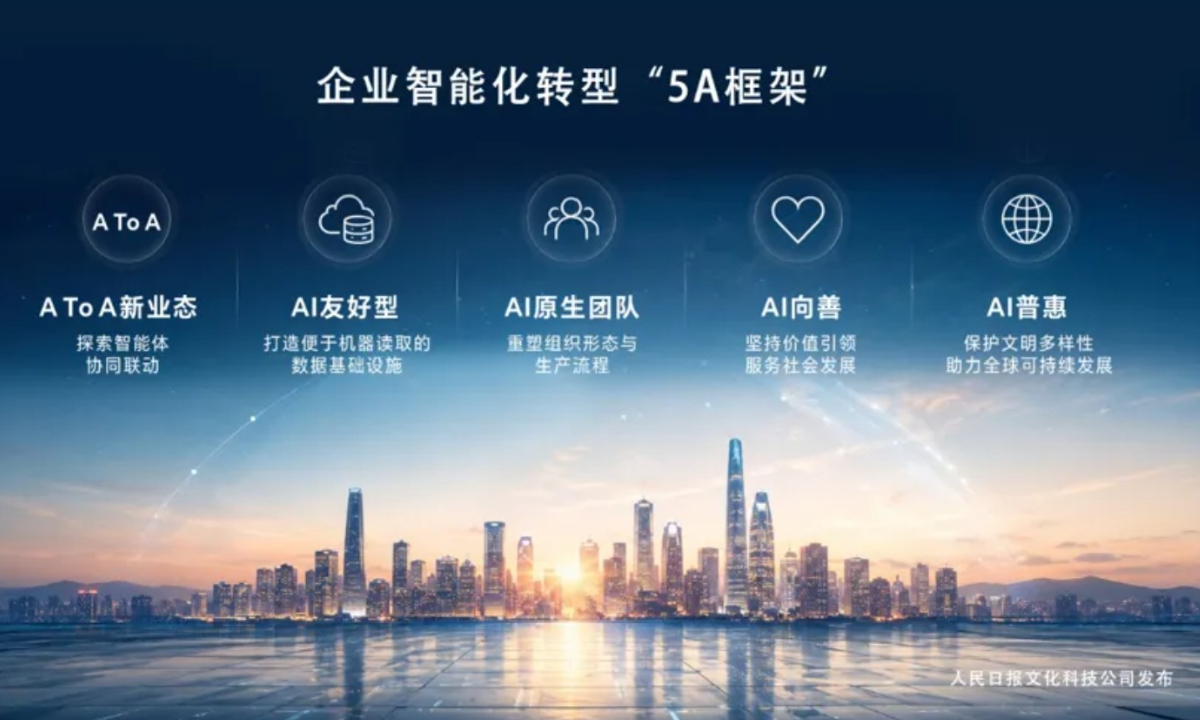
An illustration of the “5A Framework” for enterprise intelligent transformation unveiled at the 2026 Digital Intelligent Economy Forum in Langfang, North China’s Hebei Province, on August 12, 2026. Photo: people.cn
The 2026 Digital Intelligent Economy Forum was held in Langfang, North China’s Hebei Province, on Wednesday. At the forum, organizer People's Daily Cultural Technology Corporation unveiled a “5A Framework” for enterprise intelligent transformation, aimed at helping businesses comprehensively innovate their business models, organizational structures and service systems in the artificial intelligence (AI) era. A To A: Exploring new models for agent collaboration AI is pushing the internet into a new stage characterized by the widespread participation of AI agents. In the future, China could develop an ecosystem comprising tens of billions of agent applications, while the global “digital population” could reach hundreds of billions. Following To B (business-oriented) and To C (consumer-oriented) models, enterprises and institutions should actively explore the emerging To A (agent-oriented) model. To enable better interaction and coordination among agents, unified data, technology, interface and service standards need to be established, while new business systems and service models should be cultivated. AI-friendly: Building machine-readable data infrastructure Today’s internet user interfaces are primarily designed for human browsing. The first step, therefore, should be to build an “AI-friendly” data system that is better suited to being read, understood and accessed by AI. By structuring content resources and turning them into organized knowledge, while strengthening ontology systems and knowledge graphs, such a system can improve AI’s ability to understand and apply information. On this basis, integrated hardware and software infrastructure combining computing architecture with data systems can be developed for AI applications. AI-native teams: Reshaping organizations and workflows AI is profoundly reshaping organizational structures and ways of working. AI-native teams should redefine job responsibilities, organizational structures and business processes around the A-To-A model and AI-friendly services, enabling “everyone to have multiple AI agents.” Professional capabilities and business experience can be encapsulated into “digital employees,” promoting autonomous learning by agents, multi-agent collaboration and the evolution of collective intelligence, thereby multiplying per-capita productivity. AI for good: Putting values first, serving social development AI also requires values-based guidance. Guided by the principle of “being people-centered and using AI for good,” efforts should follow the approach of “governing AI with AI and guiding intelligence with wisdom,” ensuring that AI always serves social development, the public interest and people’s needs. The “Mainstream Values Corpus,” whose development was launched by the People’s Daily in May 2023, has already begun to take shape and has been validated through numerous large-model applications. Inclusive AI: Protecting cultural diversity, advancing global sustainable development AI should not become merely “a game for rich countries and rich people,” but should benefit all countries. Efforts should be made to actively participate in global initiatives for inclusive AI, bridge the digital and intelligent divide, and enable more organizations and individuals to share the benefits of development on an equal footing, so that AI can truly become a powerful positive force for improving the well-being of all humanity and advancing human civilization. This was translated and compiled by the Global Times, based on an article originally published on people.cn on August 12, 2026.
B | 2.把水烧开是一种简单有效降低微塑料含量的方法 近期关于瓶装水中微塑料的研究结果令人震惊,这让我们不得不重新审视我们的饮水习惯。对于大多数家庭来说,把水烧开是一种简单且有效的杀菌方法。 关于微塑料,烧开水确实能在一定程度上降低其含量。当水被烧开时,微塑料颗粒会与水中的碳酸钙结合,形成沉淀物。
C | 通过简单的过滤,我们可以去除高达84%的微塑料。因此,把水烧开再喝,确实是一个降低微塑料摄入的有效方法。 当水被加热至沸腾时,微塑料颗粒由于密度和大小的差异,会与水中的其他物质发生分离,一部分会沉淀到水底。因此,在烧开水之后,如果条件允许,我们可以使用过滤器或纱布进行简单的过滤,进一步减少水中的微塑料颗粒。 3.如何保证饮水安全? (1)选择质量好的瓶装水:购买瓶装水时,注意查看产品标签和认证信息,选择有质量保证的品牌。避免购买来源不明或价格过于低廉的瓶装水。 (2)定期更换水壶和水杯:即使是高质量的水壶和水杯,长期使用也可能磨损,导致微塑料产生。建议定期更换,保持清洁。
D | (3)安装家用净水器:安装家用净水器可以有效去除水中的杂质和微塑料颗粒,提供更安全的饮用水。 (4)使用不锈钢或玻璃材质水壶:烧水更安全,因为这些材质不易释放微塑料颗粒。 所以,我们要尽量避免使用塑料水壶,尤其是在高温下,塑料中的化学物质可能会加速分解,增加微塑料的风险。减塑降碳。
E | 图源:卡乐图片(摄影/宁颖) 4.减少微塑料摄入的生活小妙招 科学家建议,由于微塑料主要通过饮食和器具进入人体,一些生活方式也有助于减少微塑料的摄入。 (1)尽量减少选用预包装食品,特别是加工程度非常高的食品。每一个加工过程都可能会增加食品当中微塑料的含量,尽可能吃一些原型的食物,同时减少塑料容器包装的食品摄入。
F | (2)平时不食用动物、鱼类的内脏。
G | 海洋本身就存在着微塑料的污染,鱼类以及海产品长期生活在这个环境中,所含的微塑料就会更高,经常食用海鲜或者深海鱼,摄入微塑料的含量也会增多。 (3)减少外卖和快餐的摄入。外卖和快餐包装中常含有大量塑料,不仅可能产生微塑料,还可能含有其他有害物质。尽量自己做饭,既健康又环保。 (4)不粘锅出现划痕后尽量不要再用。大多数不粘锅的不粘涂层通常是聚四氟乙烯,也就是特氟龙,属于一种合成塑料。当炊具表面和硬物之间有强烈磨损时,可能会形成微小的聚四氟乙烯颗粒,然后污染食物被人类摄食。
H | 别用不粘锅烹调质地坚硬的食物,比如排骨,不使用尖锐的铲子,并定期更换新锅。 (透视社综合中国青年报、北京日报、封面新闻、“科普中国”微信公众号报道) 编辑:李煦、廖明娟(实习) 校对:李旭颖 审核:龚紫陌。
Current article:http://5p5l.linxiuhuaishuangniuzhenrua.bond/ygo/dop.html